
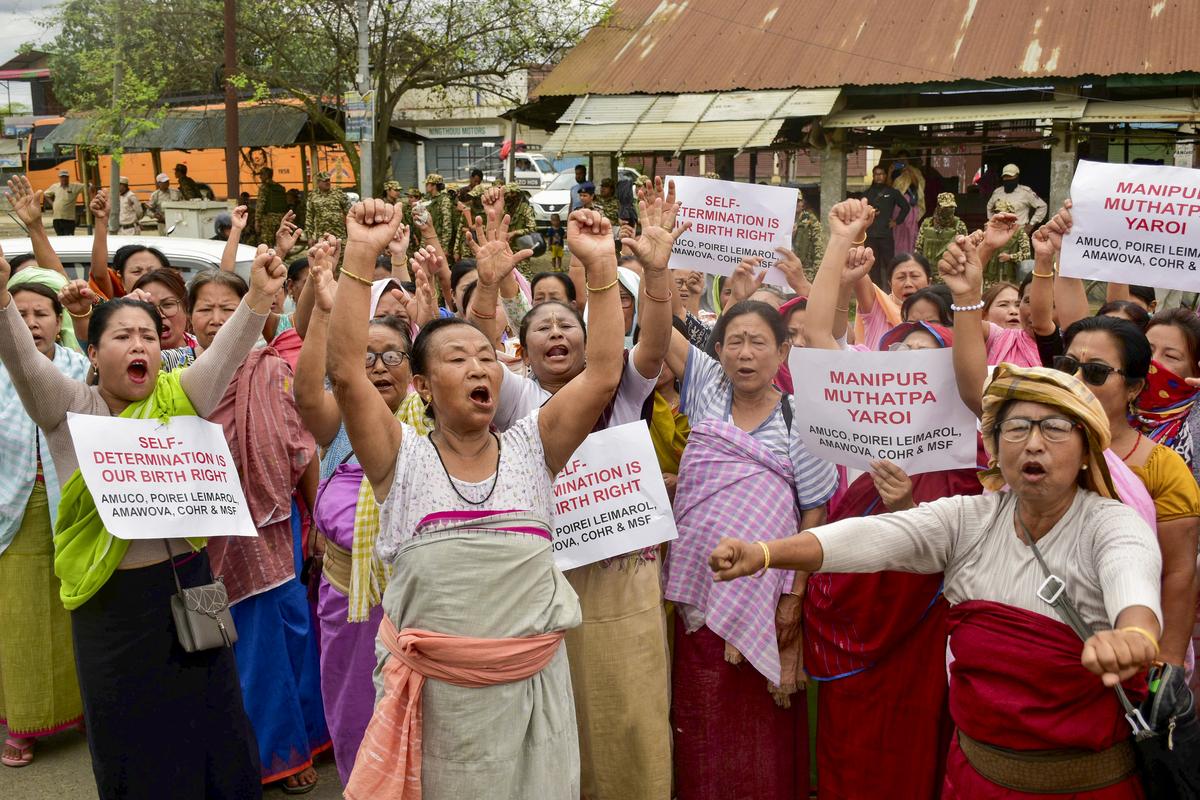
Kuki groups in Manipur demand restoration of President’s Rule and stronger security measures amid ongoing ethnic tensions.
WHAT’S THE NEWS?
Thousands of people from the Kuki community protested in Manipur demanding:
- Continuation of President’s Rule in the state.
- Extension of suspension of operations agreements.
- Creation of special security zones in vulnerable areas.
- Stronger protection for civilians after recent violence.
KEY POINTS
- Ethnic tensions continue between Meitei and Kuki communities.
- Protesters fear renewed violence if security arrangements are weakened.
- President’s Rule was imposed after instability and law-and-order concerns.
- Security forces remain deployed in sensitive districts.
- Civil society groups are demanding peace, rehabilitation, and political dialogue.
HOW IT WORKS – PRESIDENT’S RULE
- Article 356 of the Indian Constitution allows President’s Rule.
- It is imposed when the constitutional machinery in a state fails.
- The Governor reports the situation to the President.
- Parliament takes over legislative powers of the state.
- The Union Government administers the state temporarily.
EXAMPLE
Manipur came under President’s Rule due to prolonged ethnic violence, governance challenges, and security concerns affecting normal administration.
UPSC FOCUS
Prelims:
• Article 355 and Article 356
• President’s Rule and Emergency Provisions
Mains:
• Discuss the challenges of maintaining internal security in ethnically sensitive regions.
• Examine the constitutional implications of President’s Rule in states.
SUMMARY
The Manipur protests reflect continuing ethnic tensions and concerns over security in the state. The issue is significant for understanding federalism, emergency provisions, internal security, and governance challenges in India.