
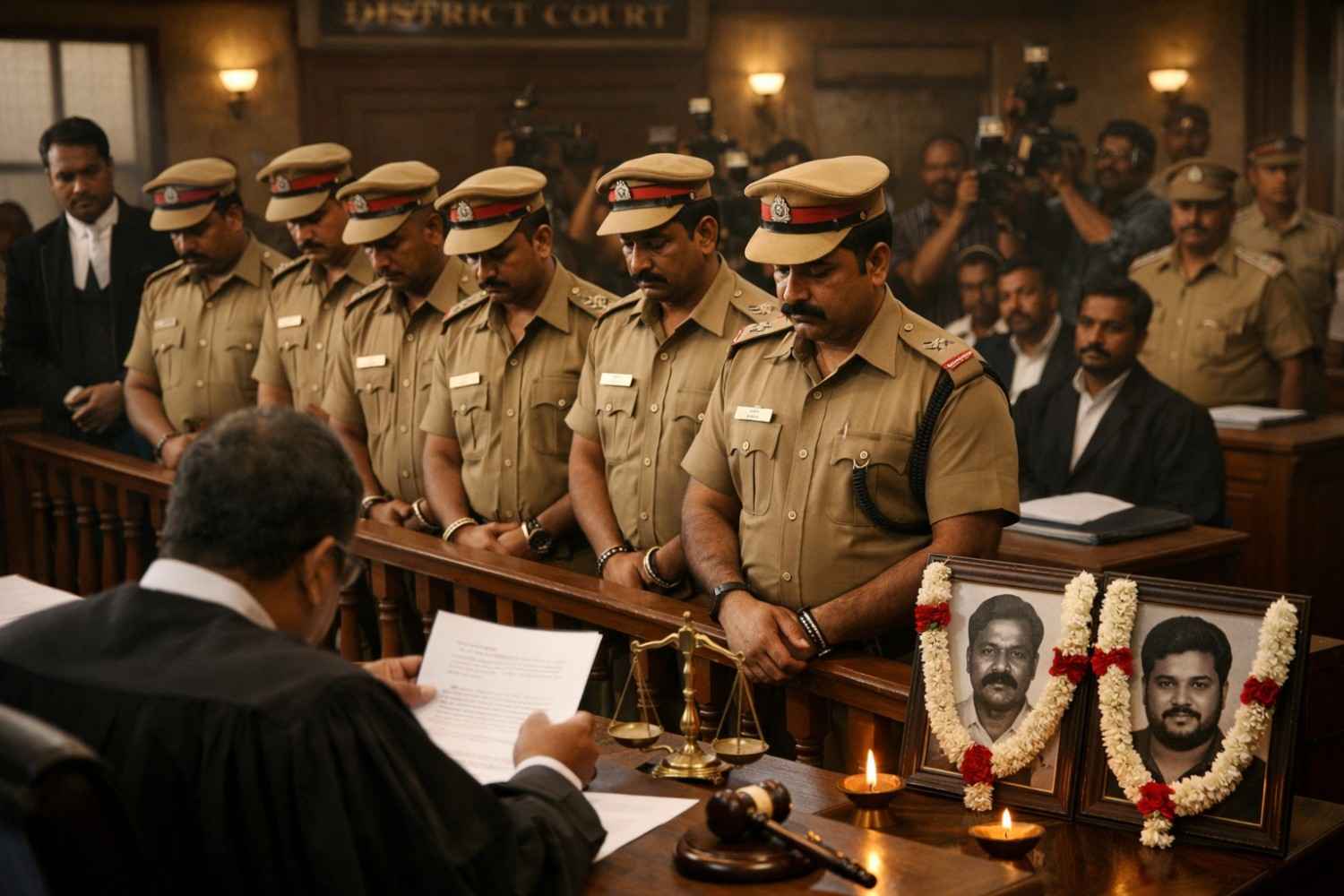
In the Sathankulam custodial deaths case, the First Additional District and Sessions Court, Madurai, on Monday (April 6), awarded the death penalty to all nine police officers convicted for the murder of Jayaraj and his son, Bennix, in 2020.
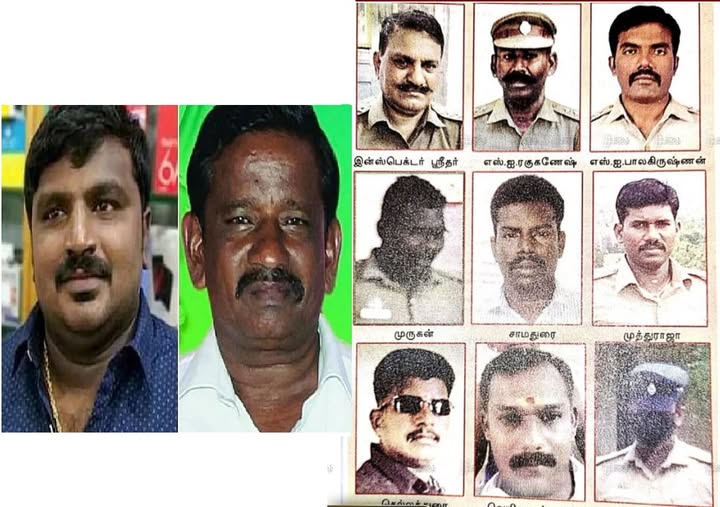
P Jeyaraj, 58, and his son Benicks, 38, both died in jail in the southern state of Tamil Nadu – days after they were detained for allegedly keeping their mobile phone shop open in breach of lockdown rules during the Covid-19 pandemic.
The two men were stripped and ruthlessly assaulted in front of each other, the sentencing judge said on Monday – describing the case as a clear abuse of authority. “They did this with the intention of killing,” he said.
The horrific custodial deaths at Sathankulam in Tamil Nadu, exposed, how a man-son duo, who died in custody, was subjected to sexual torture at the police station. The incident sent shock waves across the state, and elsewhere.
The officers, who were found guilty of murder last month, will be able to appeal against their sentences. “They attacked unarmed people. They should not be forgiven. They should not be given lesser sentences based on their age or family background. They are all educated,” the judge also said of the officers at sentencing.
In his remarks while passing the verdict, Judge G Muthukumaran said the case was a rare one where the police officers, who were obligated to maintain law and order, had themselves acted against the law and brutally assaulted the father and son, who did not have any criminal case against them.
The court has also ordered the police officers to pay a total compensation of Rs 1.40 crore to the family of the deceased.
The tragedy dates back to June 2020 during the coronavirus lockdown, when Jayaraj and Bennix were picked up for allegedly keeping their mobile phone shop open beyond permitted hours. They were subjected to extreme physical assault while in custody, leading to their deaths at a hospital days later.
Following a massive public outcry, the Madras HC took notice of the case, which was eventually investigated by the CBI.
The verdict in the 2020 custodial killings has reignited debates on the ‘rarest of rare’ doctrine, police accountability, and whether death penalty is the right response to custodial violence.
Is awarding death penalty to nine accused rare in India’s judicial history?
It is indeed rare sentencing. After the Bachan Singh judgment of 1980, death sentences are imposed only in the “rarest of rare” cases. Courts have differed on what qualifies as “rarest of rare,” but generally, a gruesome manner of killing invites such punishment.
However, in recent years, appellate courts — the High Courts and the Supreme Court — have been more liberal. Even when trial courts impose death sentences, higher courts often commute them to life imprisonment for fixed terms, like 20 years or until the end of life.
After the Nirbhaya case, you will find very few death sentences actually confirmed by the Supreme Court. There is increasing rethinking within the judiciary that death penalty is not necessarily a deterrent. Judges now look beyond the crime to the background and history of the accused.
What factors do courts consider before confirming death sentences?
The nature of the crime alone is not sufficient. Courts examine mitigating factors — the conduct of the accused, their background, and even reports from jail authorities.
If the conduct of the accused in prison is good, it can be considered a mitigating factor. Each convict must be assessed individually. Under Section 354(3) of the CrPC, courts must record “special reasons” for awarding the death penalty.
These reasons cannot be uniform for all nine convicts. They must be specific to each individual. That is why it is important to read the judgment carefully to see whether such detailed reasoning has been provided.
Can higher courts overturn or reduce this punishment?
Yes, absolutely. The trial court’s decision must be confirmed by the Madurai Bench of the Madras High Court. Only then does it become final, and even after that, the Supreme Court can review it.
One must understand the context here. The accused are not ordinary individuals — they are policemen representing the state. Custodial violence is effectively violence by the state itself.
That may have influenced the trial court to impose the highest punishment, to send a strong message. But legally, the question remains whether life imprisonment was truly “foreclosed.” That is the test laid down in Bachan Singh.
Is death penalty a deterrent, especially in cases like this?
There are strong arguments against the death penalty in principle. But those arguments carry weight only when society and the state are consistently opposed to custodial violence.
In this case, the victims were accused merely of violating COVID-19 guidelines — which itself was later found to be false. The extreme brutality of the act shocked the conscience of society. Courts often consider whether a crime shocks societal conscience. That was also seen in the Nirbhaya case. But whether death penalty deters such crimes remains an open question.
How significant is this verdict in addressing police brutality?
Custodial violence requires a separate and serious discussion. India does not have a standalone law against torture, despite signing the UN Convention Against Torture — it has not been ratified.
In this case, the CBI invoked ordinary murder provisions under the IPC. If there had been a specific anti-torture law, the prosecution might have been more effective and faster.
The delay itself shows systemic gaps. The incident happened in 2020, and even now, the legal process will continue through appeals for several more years.
What systemic gaps did this case expose?
There are serious concerns about evidence tampering. In this case, CCTV footage was reportedly erased. It was only because of independent evidence from a shopkeeper that the case progressed.
Despite Supreme Court directions, many police stations still lack proper CCTV coverage. Even where cameras exist, their integrity is questionable. This raises a larger question: will death penalty deter future custodial violence?
What reforms are actually needed to prevent such incidents?
The real issue is not the absence of death penalty. The real issue is the absence of a strong, standalone law against custodial torture.
Over 20,000 custodial deaths were reported to the National Human Rights Commission between 2015 and 2022. Very few cases reach a conclusion like this one.
We cannot respond to such a systemic problem with death sentences alone. That is neither practical nor consistent with democratic principles.
India must ratify the international anti-torture convention and enact a comprehensive domestic law. That is the real solution.
What role should judiciary and institutions play going forward?
This case offers lessons for both the state and civil society. Parliament must act to enact a law against custodial torture.
At the same time, the Supreme Court can step in. Even if Parliament does not act, the Court can lay down guidelines — as it did in the Vishaka case on sexual harassment.
There is precedent for judicial intervention where legislative gaps exist. The time has come for the Supreme Court to act, possibly suo motu, and establish uniform guidelines across the country. That would be the most meaningful tribute to the victims of this case.